Day 11: Travel by train & bus to Rodi & walk to Faido. Travel by train to Lavorgo & walk to Giornico. Travel by bus & train to Bellinzona (MAPS 3 & 4).
After breakfast they headed to the railway station of Airolo (1141m a.s.l.), which is the highest railway station of the Swiss Federal Railways (SBB) (BAHNHOF AIROLO). There they boarded the "Treno Gottardo" to Faido. In Faido they changed to a bus and got off at Rodi "Dazio Grande".
The "Dazio Grande" is a building from the middle of the 16th century. It served as customs house for goods, transit traffic, hoarse-changing station, guesthouse, hostel and warehouse until 1803, the year when the Ticino became part of the Swiss Confederation. It remained in operation, until the Gotthard railway line was inaugurated in 1882. Nowadays, it is still open for the public as a museum and provides a rustic restaurant and overnight accommodation (DAZIO GRANDE).
From there they started their hiking, which took them along the "Via Gottardo Süd", passing by the two most impressive gorges ("Piottino" and "Biaschina"), which are shaping the landscape of the upper Ticino, and ending by the village Giornico.
Day 11: Travel by train & bus to Rodi & walk to Faido. Travel by train to Lavorgo & walk to Giornico. Travel by bus & train to Bellinzona (MAPS 3 & 4).
After breakfast they headed to the railway station of Airolo (1141m a.s.l.), which is the highest railway station of the Swiss Federal Railways (SBB) (BAHNHOF AIROLO). There they boarded the "Treno Gottardo" to Faido. In Faido they changed to a bus and got off at Rodi "Dazio Grande".
The "Dazio Grande" is a building from the middle of the 16th century. It served as customs house for goods, transit traffic, hoarse-changing station, guesthouse, hostel and warehouse until 1803, the year when the Ticino became part of the Swiss Confederation. It remained in operation, until the Gotthard railway line was inaugurated in 1882. Nowadays, it is still open for the public as a museum and provides a rustic restaurant and overnight accommodation (DAZIO GRANDE).
From there they started their hiking, which took them along the "Via Gottardo Süd", passing by the two most impressive gorges ("Piottino" and "Biaschina"), which are shaping the landscape of the upper Ticino, and ending by the village Giornico.
Day 11: Travel by train & bus to Rodi & walk to Faido. Travel by train to Lavorgo & walk to Giornico. Travel by bus & train to Bellinzona (MAPS 3 & 4).
After breakfast they headed to the railway station of Airolo (1141m a.s.l.), which is the highest railway station of the Swiss Federal Railways (SBB) (BAHNHOF AIROLO). There they boarded the "Treno Gottardo" to Faido. In Faido they changed to a bus and got off at Rodi "Dazio Grande".
The "Dazio Grande" is a building from the middle of the 16th century. It served as customs house for goods, transit traffic, hoarse-changing station, guesthouse, hostel and warehouse until 1803, the year when the Ticino became part of the Swiss Confederation. It remained in operation, until the Gotthard railway line was inaugurated in 1882. Nowadays, it is still open for the public as a museum and provides a rustic restaurant and overnight accommodation (DAZIO GRANDE).
From there they started their hiking, which took them along the "Via Gottardo Süd", passing by the two most impressive gorges ("Piottino" and "Biaschina"), which are shaping the landscape of the upper Ticino, and ending by the village Giornico.
Day 11: Travel by train & bus to Rodi & walk to Faido. Travel by train to Lavorgo & walk to Giornico. Travel by bus & train to Bellinzona (MAPS 3 & 4).
After breakfast they headed to the railway station of Airolo (1141m a.s.l.), which is the highest railway station of the Swiss Federal Railways (SBB) (BAHNHOF AIROLO). There they boarded the "Treno Gottardo" to Faido. In Faido they changed to a bus and got off at Rodi "Dazio Grande".
The "Dazio Grande" is a building from the middle of the 16th century. It served as customs house for goods, transit traffic, hoarse-changing station, guesthouse, hostel and warehouse until 1803, the year when the Ticino became part of the Swiss Confederation. It remained in operation, until the Gotthard railway line was inaugurated in 1882. Nowadays, it is still open for the public as a museum and provides a rustic restaurant and overnight accommodation (DAZIO GRANDE).
From there they started their hiking, which took them along the "Via Gottardo Süd", passing by the two most impressive gorges ("Piottino" and "Biaschina"), which are shaping the landscape of the upper Ticino, and ending by the village Giornico.
Day 11: Travel by train & bus to Rodi & walk to Faido. Travel by train to Lavorgo & walk to Giornico. Travel by bus & train to Bellinzona (MAPS 3 & 4).
After breakfast they headed to the railway station of Airolo (1141m a.s.l.), which is the highest railway station of the Swiss Federal Railways (SBB) (BAHNHOF AIROLO). There they boarded the "Treno Gottardo" to Faido. In Faido they changed to a bus and got off at Rodi "Dazio Grande".
The "Dazio Grande" is a building from the middle of the 16th century. It served as customs house for goods, transit traffic, hoarse-changing station, guesthouse, hostel and warehouse until 1803, the year when the Ticino became part of the Swiss Confederation. It remained in operation, until the Gotthard railway line was inaugurated in 1882. Nowadays, it is still open for the public as a museum and provides a rustic restaurant and overnight accommodation (DAZIO GRANDE).
From there they started their hiking, which took them along the "Via Gottardo Süd", passing by the two most impressive gorges ("Piottino" and "Biaschina"), which are shaping the landscape of the upper Ticino, and ending by the village Giornico.
Day 11: Travel by train & bus to Rodi & walk to Faido. Travel by train to Lavorgo & walk to Giornico. Travel by bus & train to Bellinzona (MAPS 3 & 4).
Day 12: Visit Bellinzona & castles. Travel by train & bus to Magadino. Visit the "Bolle di Magadino" wetlands. Travel by bus & train to Locarno (Map 4).
The group met at 8 o'clock for breakfast. Then they headed direction to the historic center of Bellinzona.
Bellinzona is the capital of the Canton Ticino, has a population of about 43'000 inhabitants. The city is famous for its three medieval castles (Castelgrande, Montebello, Sasso Corbaro) (BELLINZONA).
On their way to the castles they passed by the "Piazza Collegiata", where every Saturday the traditional market takes place (SAMSTAGSMARKT BELLINZONA & Figure 64).

Figure 64: Saturday market in the "Piazza Collegiata" Bellinzona
There were lots of market stalls in the colors blue and red of the Ticino flag, selling local products from the region. One stall attracted them particularly, because the seller was throwing to the passers-by free "Amaretti" biscuits to taste. Giovanni, who loved sweets, spend a short while to exchange some words with the seller and bought a large sack which he shared with the group.
Leaving the market site they headed to the castles. The dukes of Milano have erected them in this narrowing valley of the "Ticino" river around the 15th century, due to optimal position along the north-south axis of the alpine road (St. Gotthard, Lukmanier, San Bernardino, Nufenen). Their aim was to block the obligatory passage for the Swiss, direction south. In the year 2000 the castles were taken into cultural heritage by the UNESCO (BELLINZONA BURGEN).
The first, "Castelgrande" (Figure 65), they reached by climbing several steps through a narrow alley. It has two towers, is surrounded by a crenelled wall and was renovated by the architect Aurelio Galfetti in the 1980 and 1990ties. The castle also harbors a museum (BELLINZONA BURGEN).

Figure 65: "Castelgrande" castle with the crenelled walls
Following the fall of the regime by the dukes of Milano at the beginning of the 16th Century, Bellinzona was occupied by the Swiss, the three castles had to be given to the three founding cantons: Schwyz, Uri and Unterwalden. The "Castelgrande" was given the name "Castello di Uri", the "Montebello" castle was called " Castello di Svitto (Schwyz)" and "Sasso Corbaro" "Castello di Unterwaldo (Unterwalden)" (BELLINZONA BURGEN).
On the castle's terrain they walked along the crenelled walls and enjoyed the marvelous panoramic view to the other two castles, "Montebello" and "Sasso Corbaro" (Figure 66).
_corr.jpg)
Figure 66: View from the "Castelgrande" to the castles "Montebello" and "Sasso Corbaro"
From the "Castelgrande" they descended back the same narrow alley to the "Piazza Collegiata" and went through another steep and narrow path upwards to the "Castello Montebello". On their way they saw several plants growing between the rocks (Figure 67, left picture) and quite a number of palm trees. The Ticino palm tree (Trachycarpus fortunei), which was imported from Asia, is nowadays frequently found in several places, including many private gardens, and a disliked weed (TESSINER PALME).

Figure 67: Hiking path to the "Montebello" castle
They reached the "Montebello" castle (Figure 67, right picture), which is located 90m above the city of Bellinzona (Figure 68).
The castle complex was restored several times. It harbors like the "Castelgrande" a museum with historical and archaeological findings (BELLINZONA BURGEN).

Figure 68: "Montebello" castle
When they reached the "Montebello" castle they had a clear view to the "Castelgrande" with its long surrounding defense wall
(Figure 69).

Figure 69: View from the "Montebello" castle to the "Castelgrande"
Leaving the "Montebello" castle they first passed some vineyards, then followed a steep path through a sparse forest and could identify the edifice of the third castle, the "Sasso Corbaro" (Figure 70), which is the highest of the three Bellinzona castles and stands 230 meters above the city. The construction of the castle took only 6 month subsequent to the battle of Giornico in the year 1479 (BELLINZONA BURGEN ).

Figure 70: "Sasso Corbaro" castle

Figure 71: "Sasso Corbaro" castle with view to the "Magadino" plain and the "Lago Maggiore" lake
From the top of the castle they enjoyed a bright view to the city of Bellinzona as well as the "Lago Maggiore" lake (Figure 71). A few minutes later, they followed the same path back to the "Piazza Collegiata" and stopped for lunch at the "Ristorante Peverelli", located in the heart of the piazza. After that rather intensive cultural tour of the castles, they went back to their hostel to pick up their luggage and headed to the Bellinzona railway station. There they checked-inn their belongings to the final destination Locarno and boarded the train to Cadenazzo.
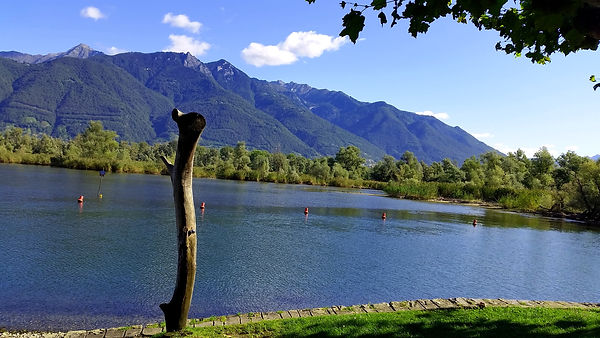
The trip to Cadenazzo was only 10min. From there they changed to a bus direction to Magadino and followed the walking track to the swamps of the "Magadino" plain, known as the "Bolle di Magadino" (Figure 72), which is a large area of swamps in the estuary of the "Ticino" and "Verzasca" river. It belongs to one of the major naturally kept wetlands in Switzerland. They provide an important resting habitat for over 200 migrating birds before crossing the Alps and are an important site for further 60 bird species, as for amphibians, dragonflies and butterflies. Since 1979 the area is under nature conservation (BOLLE DI MAGADINO).

Figure 72: Nature reserve "Bolle di Magadino"
In the "Bolle di Magadino" they visited the estuary area of the "Ticino" river and followed an interesting nature trail. There the "Ticino" river breaks into several small arms, that got cut-off from the main river. The group continued further through the densely forested area and passed by straw meadows and little ponds, which are an important breeding area for birds. From there the path went along the dam of the "Ticino" river, which gets over flooded during a larger high water cycle and is responsible for the development of a floodplain pioneer forest. The floodplain pioneer forests of the "Bolle di Magadino" are still young and only few trees are older than 50 years. The nature trail took them further to the estuary, where they passed a large area of sandbanks, which have been renaturalized.
Their tour through the "Bolle" took them approximately one hour. Then they headed to the small village of Magadino and spend the rest of the afternoon relaxing at the lido (Figure 73).
_corr.jpg)
Figure 73: Magadino lido
At the stop Magadino "Casa Comunale" they boarded the bus back to Cadenazzo and changed from there to the Treno Gottardo to Locarno. They picked up their luggage and took a bus to their overnight place, hostel "Palagiovani", which is located in the unique Youth Palace "Palagiovani", a short bus ride from the railway station and close to the historic center of the famous "Piazza Grande".
Locarno is after Lugano and Bellinzona the third largest city in the canton Ticino and has a population of almost 16'000 inhabitants. It has the mildest climate in Switzerland with approximately 2300 sunshine hours a year (LOCARNO). Locarno has therefore a Mediterranean climate where several evergreen and thermophilous plants of the insubric vegetation (e.g., azalea, camellias and magnolia) are frequently found as well as other exotic plants, such as, citrus trees (INSUBRISCHE VEGETATION; LOCARNO). The city has a large park with over 850 different camellia species and got the award as "Gardens of Excellence" from the International Camellia Society
(Figure 74 & KAMELIENPARK).

Figure 74: Camellia park in Locarno
The pilgrim church "Madonna del Sasso" in Orselina above Locarno is the landmark of the city. A further important place of interest is the "Piazza Grande" (Figure 75) with its arcades, which belongs to one of the largest and best-known city square in Switzerland. It is famous for its several summer events taking place there, such as the Locarno film festival or the music festival moon & stars (LOCARNO).

Figure 75: "Piazza Grande" in Locarno
As it was end of August, all the events were already over. It was quiet and not crowded in the "Piazza Grande", where they found in a side street the restaurant "La Trattoria". In the homely arranged tavern they tried a further typical specialty from the Ticino, a risotto. The rise is locally produced in the "Maggia" delta. They enjoyed the meal and were once more impressed by the delicious cuisine of the Ticino.
Later they strolled along the lake promenade direction to the Lido. Along the lake shore there were lots of sail and yacht boats parked.
Way in the back they could see as far as to the "Bolle di Magadino". Behind the lido they found a peaceful park "Parco della Pace"
(Figure 76), which means the Peace Park and was set up in 1965 on the occasion of the commemoration event of the 40th anniversary of the peace conference (5 to 16 October 1925) held in Locarno between Germany, France, Belgium, England, Italy, Poland and Czechoslovakia (PARCO DELLA PACE). There they enjoyed the peaceful late evening atmosphere.

Figure 76: "Parco della Pace"